
Podcasts are an incredible way to gain insights from top industry leaders, whether you’re looking to sharpen your leadership skills, understand business strategies, or explore the world of scaling and investments.
We’ve rounded up five standout podcasts that provide valuable takeaways for business professionals.
1. Coaching for Leaders
Host: Dave Stachowiak
Episode Length: 20–40 minutes
If you’re a business owner or professional looking to enhance your leadership and management skills, Coaching for Leaders is a must-listen. Hosted by Dave Stachowiak, this podcast features expert guests covering a wide range of topics, including effective communication, team dynamics, emotional intelligence, and decision-making.
With more than 700 episodes since 2011, Stachowiak has spoken with renowned experts such as professors from Cornell and Columbia, the former CEO of AT&T Business, and The 7 Habits of Highly Effective People author Stephen R. Covey. We especially love that the Coaching for Leaders website offers a free, searchable database to help listeners find episodes by topic.
Where to Listen:
• Spotify
• Apple Podcasts
2. Business Breakdowns
Host: Various industry experts
Episode Length: Around 60 minutes
Ever wondered how the world’s biggest companies operate? Business Breakdowns provides deep dives into well-known brands, covering their history, business model, financials, and culture. Each episode features company executives or relevant experts who share their insights into the strategies behind major corporations.
This year alone, the podcast has covered Sony, Nintendo, and luxury group Kering, whose CEO is François-Henri Pinault. Past episodes have broken down iconic businesses such as Rolex, Hermès, and even the National Football League. If you’re an entrepreneur looking for lessons from the best, this podcast delivers insightful takeaways every week.
Where to Listen:
• Spotify
• Apple Podcasts
3. The Silicon Valley Podcast
Host: Shawn Flynn
Episode Length: 30–60 minutes
Hosted by venture capitalist and startup expert Shawn Flynn, The Silicon Valley Podcast takes listeners into the heart of the tech world. Since 2018, Flynn has leveraged his experience working with investors, accelerators, incubators, and government leaders to bring insightful interviews with some of the most successful entrepreneurs, inventors, and investors.
Covering topics like venture capital, tech entrepreneurship, and startup funding, this podcast is a must-listen for anyone interested in the Silicon Valley ecosystem. With new episodes dropping every Wednesday, there’s always something fresh and relevant for business leaders to learn.
Where to Listen:
• Spotify
• Apple Podcasts
4. The Science of Scaling
Host: Mark Roberge
Episode Length: 12–30 minutes
Scaling a business is no easy feat, but The Science of Scaling aims to demystify the process. Hosted by Mark Roberge—Senior Lecturer at Harvard Business School, Co-Founder at Stage 2 Capital, and Founding CRO at HubSpot—this podcast uncovers the science behind scaling revenue and sales.
Each week, Roberge interviews top sales leaders in tech to break down what works (and what doesn’t) when it comes to growing a company. If you’re a founder, sales executive, or growth strategist, this podcast provides actionable insights in digestible, short episodes.
Where to Listen:
• Spotify
• Apple Podcasts
5. How I Built This with Guy Raz
Host: Guy Raz
Episode Length: 30–60 minutes
Hosted by the renowned journalist Guy Raz, How I Built This delves into the stories behind some of the world’s best-known companies. Each episode features interviews with founders and co-founders who share their journeys, challenges, and triumphs in building successful businesses.
Covering topics like entrepreneurship, business strategy, and innovation, this podcast is a treasure trove of insights and inspiration for entrepreneurs, startup enthusiasts, and anyone interested in the business world. Listening to these success stories provides valuable lessons and motivation, making it one of the top business podcasts of 2025.
Where to Listen:
• Wondery
• Spotify
• Apple Podcasts
These five podcasts offer fresh perspectives, expert strategies, and real-world lessons from top leaders. Whether you’re refining your leadership approach, exploring new business models, or staying ahead of industry trends, each episode provides valuable takeaways to help you grow and lead with confidence.
Plug in, listen, and keep learning from the best!















 Most established companies have deployed such digital technologies as the cloud, mobile apps, the internet of things, and artificial intelligence. But few established companies are designed for digital. This book offers an essential guide for retooling organizations for digital success. In the digital economy, rapid pace of change in technology capabilities and customer desires means that business strategy must be fluid. As a result, the authors explain, business design has become a critical management responsibility. Effective business design enables a company to quickly pivot in response to new competitive threats and opportunities. Most leaders today, however, rely on organizational structure to implement strategy, unaware that structure inhibits, rather than enables, agility. In companies that are designed for digital, people, processes, data, and technology are synchronized to identify and deliver innovative customer solutions―and redefine strategy. Digital design, not strategy, is what separates winners from losers in the digital economy.
Designed for Digital offers practical advice on digital transformation, with examples that include Amazon, BNY Mellon, DBS Bank, LEGO, Philips, Schneider Electric, USAA, and many other global organizations. Drawing on five years of research and in-depth case studies, the book is an essential guide for companies that want to disrupt rather than be disrupted in the new digital landscape.
Most established companies have deployed such digital technologies as the cloud, mobile apps, the internet of things, and artificial intelligence. But few established companies are designed for digital. This book offers an essential guide for retooling organizations for digital success. In the digital economy, rapid pace of change in technology capabilities and customer desires means that business strategy must be fluid. As a result, the authors explain, business design has become a critical management responsibility. Effective business design enables a company to quickly pivot in response to new competitive threats and opportunities. Most leaders today, however, rely on organizational structure to implement strategy, unaware that structure inhibits, rather than enables, agility. In companies that are designed for digital, people, processes, data, and technology are synchronized to identify and deliver innovative customer solutions―and redefine strategy. Digital design, not strategy, is what separates winners from losers in the digital economy.
Designed for Digital offers practical advice on digital transformation, with examples that include Amazon, BNY Mellon, DBS Bank, LEGO, Philips, Schneider Electric, USAA, and many other global organizations. Drawing on five years of research and in-depth case studies, the book is an essential guide for companies that want to disrupt rather than be disrupted in the new digital landscape.
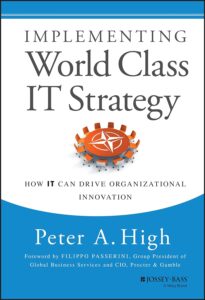 Expert technology strategist Peter High emphasizes the acute need for IT strategy to be developed not in a vacuum, but in concert with the broader organizational strategy. This approach focuses the development of technology tools and strategies in a way that is comprehensive in nature and designed with the concept of value in mind. The role of CIO is no longer “just” to manage IT strategy―instead, the successful executive will be firmly in tune with corporate strategy and a driver of a technology strategy that is woven into overall business objectives at the enterprise and business unit levels.
 Maximum innovation happens at the edge of chaos: the messy, risky, and uncertain threshold between randomness and structure. Operating there is uncomfortable but it’s where organizations “invent the future.” EDGE is a set of fast, iterative, adaptive, lightweight, and value-driven tools to achieve digital transformation.
 When turbulence is the new normal, an organization’s survival depends on vigilant leadership that can anticipate threats, spot opportunities, and act quickly when the time is right.
  A penetrating examination of the new technologies that are disrupting business and government—and how organizations can harness them to transform into digital enterprises. The confluence of four technologies—elastic cloud computing, big data, artificial intelligence, and the internet of things —is fundamentally changing how business and government will operate in the 21st century. Siebel guides readers through a fascinating discussion of the game-changing technologies driving digital transformation and provides a roadmap to seize them as a strategic opportunity. He shows how leading enterprises such as Enel, 3M, Royal Dutch Shell, the U.S. Department of Defense, and others are applying AI and IoT with stunning results.
 Depending on the size of your organization and the size of your budget hygiene team, you may find more lasting and scalable success by starting with one business unit. This is also important as different units – say Marketing or HR – require their own unique set of technology tools and resources.
  What challenges do you foresee? How will you record and organize the data? Do you have the support of most if not all of the key stakeholders? Are employees going to be resistant to any changes?
 Similar to taking stock of your personal habits, you need a clear picture of your organization’s current state before you can possibly make informed budget choices. After you’ve identified the business vertical you want to start with, collect and organize a complete inventory of the following:
 After you’ve collected all the necessary data, analyze it by asking the following questions:
 Executing on budget decisions is bound to encounter obstacles. Most likely, not all stakeholders are going to be supportive. Many employees are going to resist any changes to the way they are used to doing things. Hopefully, all of these obstacles were foreseen and prepared for. Continue to listen and acknowledge the validity of any concerns and communicate all the benefits of the new technology initiatives.